

Most businesses know they need backlinks. Fewer know where those backlinks come from or what actually happens between hiring an agency and seeing links go live.
It is a fair question. Link building is one of the least visible parts of SEO. Unlike a redesigned homepage or a published blog post, the work happens in inboxes, spreadsheets, and publishing platforms your clients never see.
This article walks through exactly what a link building agency does step by step. So, you know what you are paying for, what realistic timelines look like, and how to tell whether a campaign is being run well or not.
TL;DR
- A link building agency handles the full backlink acquisition process- prospecting, outreach, content, QA, and reporting so you can focus on your core business
- The work happens across 9 distinct steps, from competitor gap analysis through to a live link report delivered to your inbox.
- Quality is everything. Links must come from real, topically relevant sites with organic traffic not just high domain rating scores.
- Personalised, one-to-one outreach emails drive placements. Generic templates get ignored. Response rates average 5–15% even when done well.
- Ranking movement takes 3–6 months after links go live. This is normal it is how Google processes new backlinks, not a sign the campaign is not working.
- Transparent reporting with live URLs, host metrics, anchor text is the minimum standard. Any agency that cannot provide this is a red flag.
What a Link Building Agency Actually Is?
A link building agency builds backlinks to your website from other websites. That is the short version.
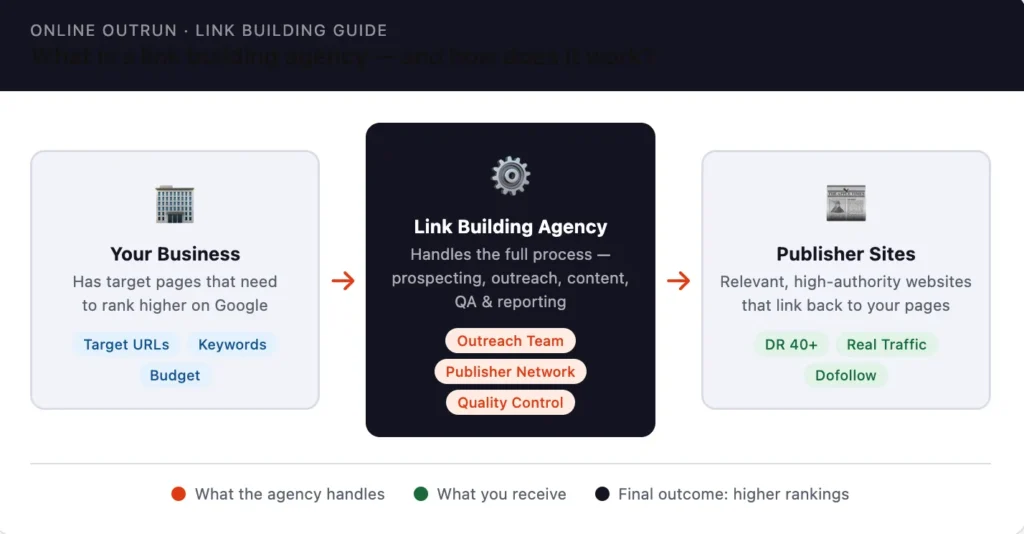
The longer version they handle the entire process of identifying relevant, authoritative websites, reaching out to the people who run them, creating content where needed, negotiating placements, and getting your link live on someone else’s site. Then they report back on what was built.
The agency supplies the team, the tools, the publisher relationships, and the quality control. You supply the target URLs, the keywords, and the budget.
What separates a link building agency from a general SEO agency is focus. Link building requires dedicated outreach staff, content writers, and a publisher network that takes years to build. Most SEO agencies run link building as one of many services and some even opt white label link building services. Specialized link building agencies do nothing else, which means faster execution and better placements.
| A quick note on quality Not every link building agency operates the same way. Some use manual outreach and genuine editorial relationships. Others use automated tools and link farms that can trigger Google penalties. The step-by-step process below describes how a legitimate, white-hat agency operates. |
The Step-by-Step Process: What a Link Building Agency Does
A well-run link building campaign follows a consistent sequence. Here is what each stage actually involves.
1. Client Onboarding and Campaign Brief
Before any outreach begins, the agency needs to understand the campaign. This means collecting the target URLs (which pages need links), the primary keywords each page targets, any anchor text preferences, the minimum domain rating threshold, the niche or industry, and any competitor domains to analyse. This brief shapes every decision that follows. Good agencies ask detailed questions upfront and often run their own analysis before building the first prospect list.
2. Competitor Backlink Analysis
The agency uses tools like Ahrefs or Semrush to pull the backlink profiles of your top-ranking competitors. This does two things, first, it shows which domains are already linking to sites in your niche these are pre-qualified prospects because they have demonstrated willingness to link to relevant content. Second, it reveals the link gap between your site and the sites outranking you, which helps set a realistic target for how many links the campaign needs to build and over what timeframe.
3. Prospect Research and List Building
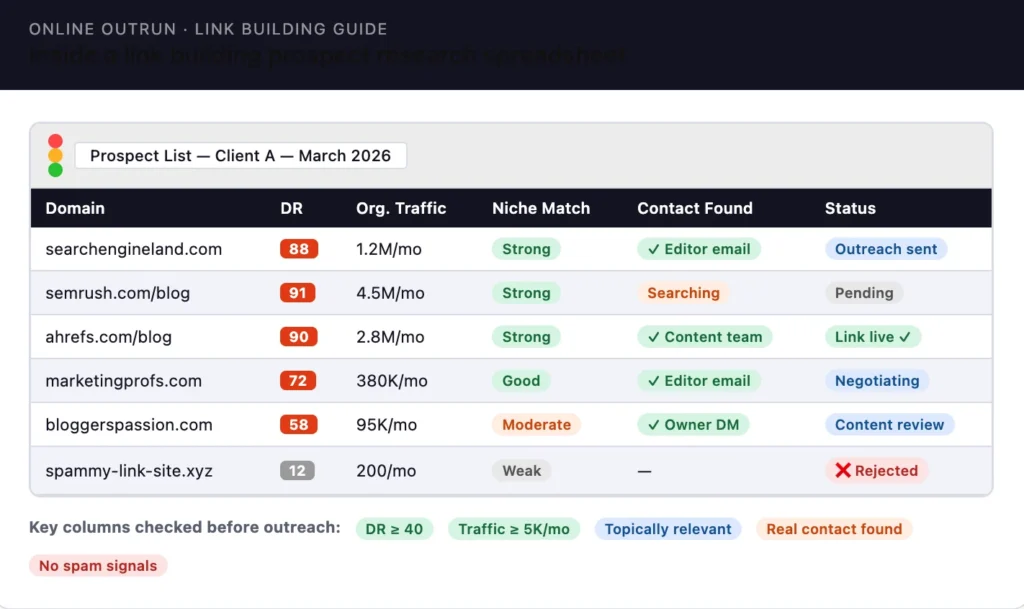
This is where the real legwork starts. The outreach team builds a list of websites that are topically relevant to your niche, active and regularly updated, within the agreed domain rating range, and free from spam signals. For each prospect, the team checks organic traffic not just DR (a high-DR site with zero traffic is a weak placement), looks at the site’s existing content quality, and confirms the site accepts editorial placements or guest posts. A typical campaign generates 50–200 qualified prospects per month, depending on niche and volume targets.
4. Finding the Right Contact
Sending outreach to a generic info@ address gets ignored. The team identifies the specific person to contac usually the editor, content manager, or site owner using tools like Hunter.io, snov.io or LinkedIn. On many sites, the contact details are listed in the ‘Write for Us’ page or in the author bios on others, it takes manual research. Getting the right name and a direct email address meaningfully improves response rates.
5. Writing and Sending Personalised Outreach Emails
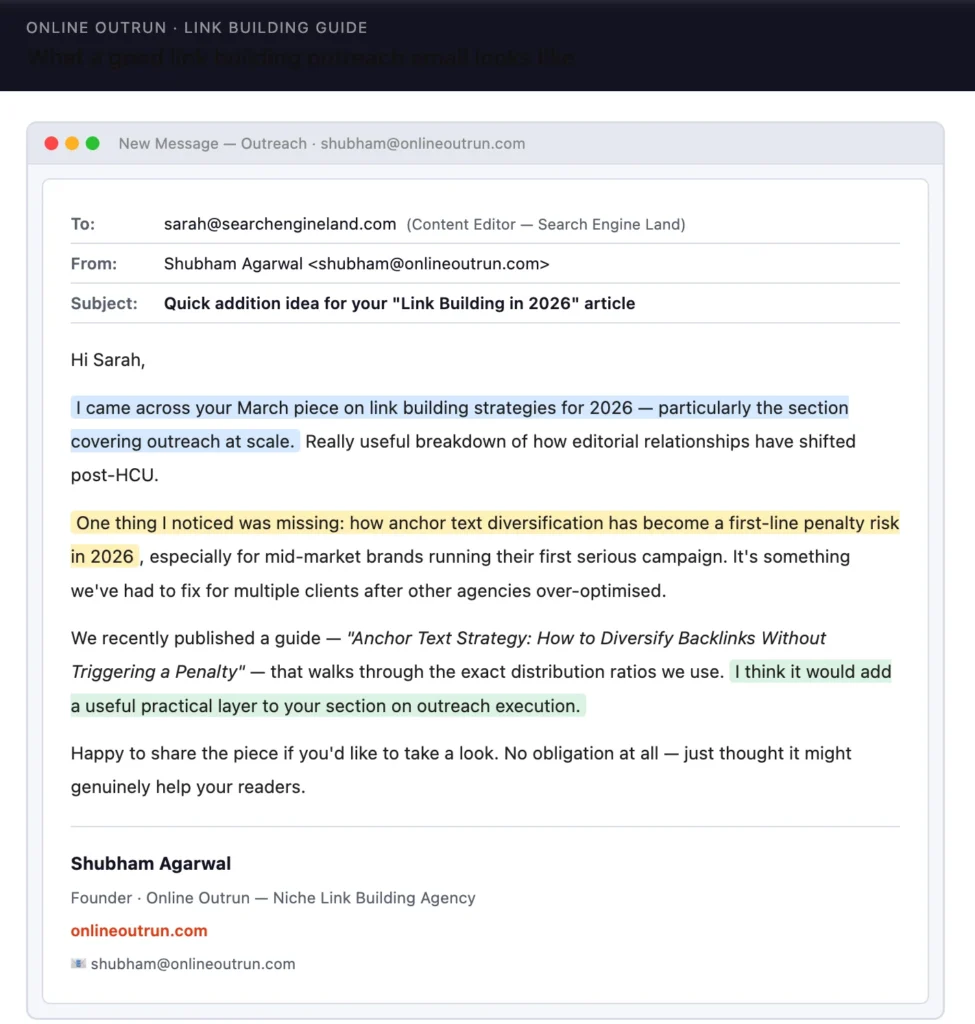
This is where most in-house attempts at link building fall apart. Generic outreach emails like ‘Hi, I love your blog, would you like a guest post?’ usually get ignored or filtered as spam. Response rates on cold outreach average between 5% and 15% even when done well. Good agencies write emails that reference something specific about the target site, explain clearly what they are offering and why it is relevant to the site’s audience, and make it easy for the recipient to say yes. Each email is personalised to the individual site, not copy-pasted from a template. Follow-up sequences go out to non-responders after three to five days.
6. Negotiation and Placement Agreement
When a site owner responds positively, the negotiation begins. This might involve agreeing on the topic or angle for a guest post, which existing article a niche edit will go into, the placement of the link within the content (body content vs. footer), the anchor text, and whether there is a cost involved for the placement. Not every placement has a fee, many publishers accept guest contributions at no cost in exchange for quality content. A reputable agency is transparent about this and factors any fees into the campaign budget.
7. Content Creation
For guest posts, the agency’s writing team produces an article that is relevant and genuinely useful to the host site’s audience, meets the publisher’s editorial standards, and includes your backlink placed naturally within the body content. For niche edits (inserting a link into an existing article), the team identifies the right paragraph, writes a natural insertion sentence, and submits it to the site owner for approval. The content quality matters here because publishers reject poor-quality submissions, and even if they do not, Google devalues links from thin, low-effort content.
8. Quality Assurance Before Delivery
Before marking a link as delivered, the agency checks is the link live and indexable? Is it dofollow? Is the anchor text exactly as agreed? Is the surrounding content relevant? Does the host domain still look clean (no sudden spike in spam, no Google penalty)? This QA pass is what separates a professional agency from a cheap link seller. Skipping it means delivering links that do not work, have the wrong anchor text, or come from sites that have deteriorated since the prospecting stage.
9. Reporting
The agency delivers a report showing every link built during the campaign period. A proper report includes the live URL where the link appears, the anchor text used, the host domain’s DR and estimated organic traffic, and the target page the link points to. Some agencies also track ranking movement on the target keywords over time and include that in monthly updates. This is useful for showing clients the connection between link building and organic performance, even though ranking improvements typically take three to six months to show up.
Tools a Link Building Agency Uses Day-to-Day
Running campaigns at scale requires specific tools. Here is what most agencies rely on:
- Ahrefs or Semrush – for competitor backlink analysis, prospect research, DR checks, and tracking referring domain growth
- Hunter.io or Apollo – for finding and verifying contact email addresses
- Pitchbox, Respona, or Mailshake – outreach management platforms that handle personalised email sequences and follow-ups
- Google Sheets or a project management tool – for managing prospect lists, tracking outreach status, and coordinating across the team
- Surfer SEO or Clearscope – some agencies use these for optimising guest post content before submission
- Majestic – for Trust Flow and Citation Flow metrics as a secondary quality check on prospects
The tools alone cost $500–$1,500 per month before accounting for staff. This is part of why building an in-house link building operation is expensive to do properly.
How Long Does the Process Take?
This is the question clients ask most often, and the honest answer is longer than most people expect.
Here is a realistic timeline breakdown:
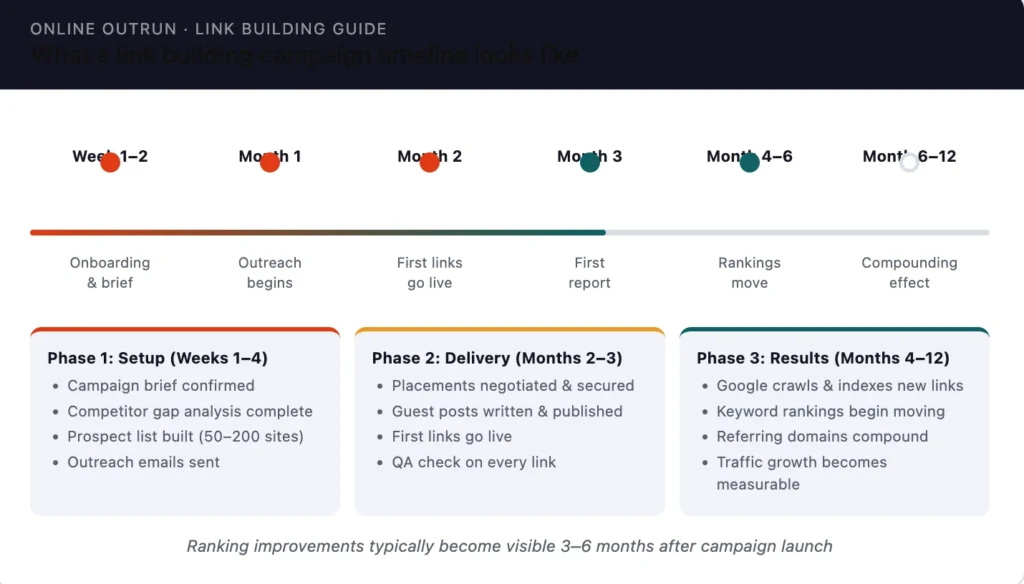
- Week 1–2: Onboarding, brief, competitor analysis, initial prospect list building
- Week 2–4: Outreach begins, first responses come in, content briefs assigned
- Month 2: First links go live, outreach continues at scale
- Month 3: Steady link delivery, first campaign report delivered
- Month 4–6: Ranking movement becomes measurable as Google processes new links
- Month 6–12: Compounding effect — each new link adds to an already-strengthening profile
The delay between links going live and rankings moving is normal. Google crawls, indexes, and evaluates new links within the context of the site’s full backlink profile. Patience at this stage is not a sign that the campaign is not working, it is how link building works.
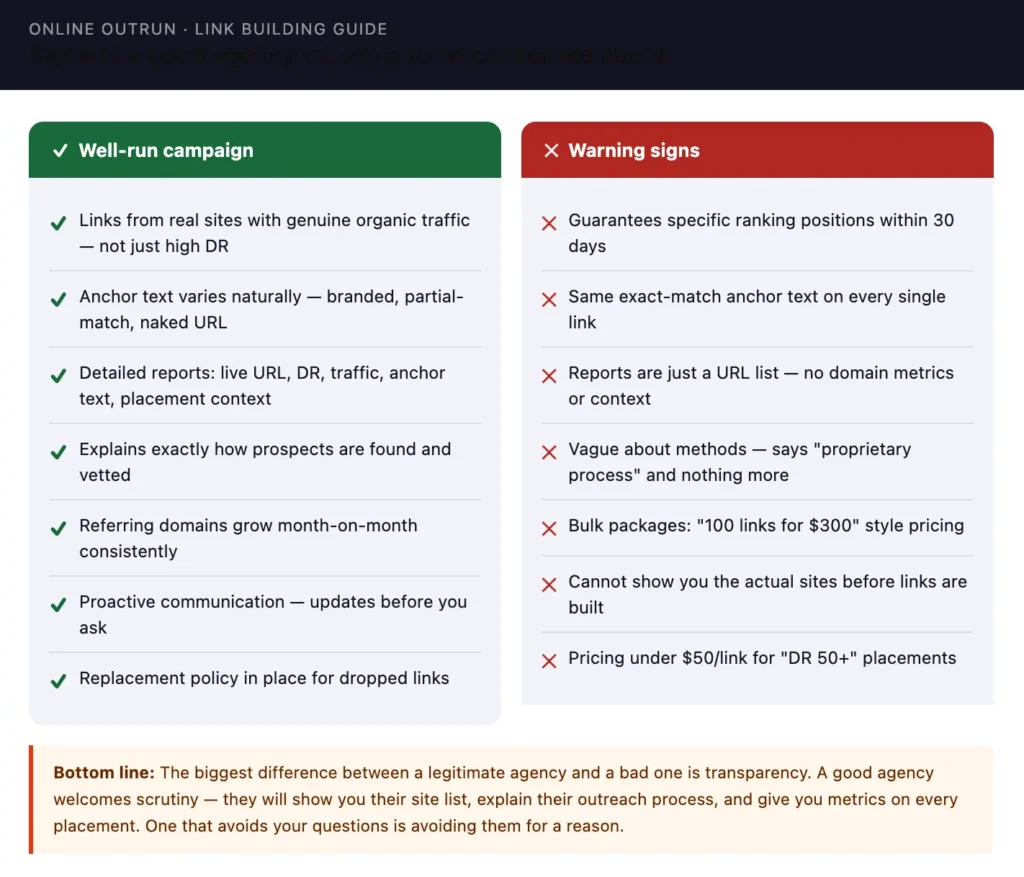
How to Know If Your Agency Is Doing It Right
Not all link building agencies run clean campaigns. These are the signs of a well-run engagement and the signs of one to be concerned about.
Conclusion
Link building is not a mystery, but it is genuinely hard work. The process involves research, personalised outreach, content creation, negotiation, quality control, and reporting all running simultaneously across dozens or hundreds of prospects at once.
Understanding what a link building agency does step by step helps you evaluate whether a provider is running a real campaign or just sending links from low-quality sites. It also helps you have more productive conversations about timelines, targets, and what success actually looks like.
If you want a link building agency that handles the full process from prospect research to branded reports we will be happy to help. At Online Outrun we works with digital first businesses and SEO agencies across a range of niches. Get in touch to see what a link building campaign looks like for your site.
FAQs – What Link Building Agency Do?
How is a link building agency different from an SEO agency?
Most SEO agencies offer link building as one of several services. A link building agency focuses on backlinks only. This means a dedicated outreach team, a more established publisher network, and generally faster delivery. For campaigns where link building is the main lever, a specialist agency often produces better results than a general SEO agency running outreach on the side.
How link building agency find prospects?
They start with competitor backlink analysis identifying which domains already link to sites similar to yours. They also search for relevant blogs, industry publications, and resource pages manually, and use content explorer tools to find topically relevant sites with organic traffic. Each prospect is vetted for domain quality, relevance, and likelihood to accept a placement before any outreach is sent.
How many links is right for my business per month?
This depends on the niche and the budget. For most campaigns, five to fifteen high-quality links per month is a realistic output from a reputable agency. Volume-focused providers may promise more, but quality — measured by topical relevance and actual organic traffic on the host domain — matters far more than quantity.
What does a link building agency do when a link drops?
At Online Outrun we monitor placed links and have a replacement policy when a link goes offline. Authentic agencies offer to replace dropped links at no extra cost within a defined window (usually 30–90 days). Ask about this policy before you sign.
How do I know the links are real and not from a PBN?
Check the host domains yourself in Ahrefs or Semrush. Real sites have organic traffic, a consistent publishing history, and a clean backlink profile of their own. PBN sites typically have very little organic traffic, thin content, and a suspicious number of outbound links. A transparent agency will show you the site list before building links and welcomes this kind of scrutiny.
What your monthly link building report will include?
At minimum the live URL where each link appears, the anchor text used, the host domain’s DR and estimated organic traffic, and the target page the link points to. If required we can also include a month-over-month summary of referring domain growth and keyword ranking changes on the pages receiving links.