

Google’s AI Overviews now appears on all searches on all location and it boost Google searched by 49%, according to BrightEdge’s 2025 AI Search Report. ChatGPT handles over 100 million queries per day. Perplexity reached 10 million daily active users.
These are not small shifts. They change where people get answers, which brands get mentioned, and whether your site gets any traffic from a query at all. And the companies showing up inside AI-generated answers are not there by accident.
Backlinks are still a major part of how that works. The relationship between link building and AI search is direct, even if it does not work in exactly the same way as traditional ranking. This article covers why, and what you need to do about it.
TL;DR
- AI search tools like Claude, ChatGPT, and Google AI Overviews source answers from pages with strong backlink profiles and established topical authority.
- Brand mentions without a hyperlink count as trust signals for LLMs. Link building generates both the backlink and the brand mention.
- Pages cited in AI overviews have an average DR of 70, according to Semrush’s AI Visibility Report.
- Topical authority matters more than domain authority in AI search. Build links from relevant sources, not just high-DR ones.
- The strategies that get cited in AI overviews digital PR, expert content, editorial guest posts are the same ones that build long-term Google rankings.
- There is no separate SEO track for AI and a different one for Google. One content and link building strategy covers both.
How AI search tools decide what to cite
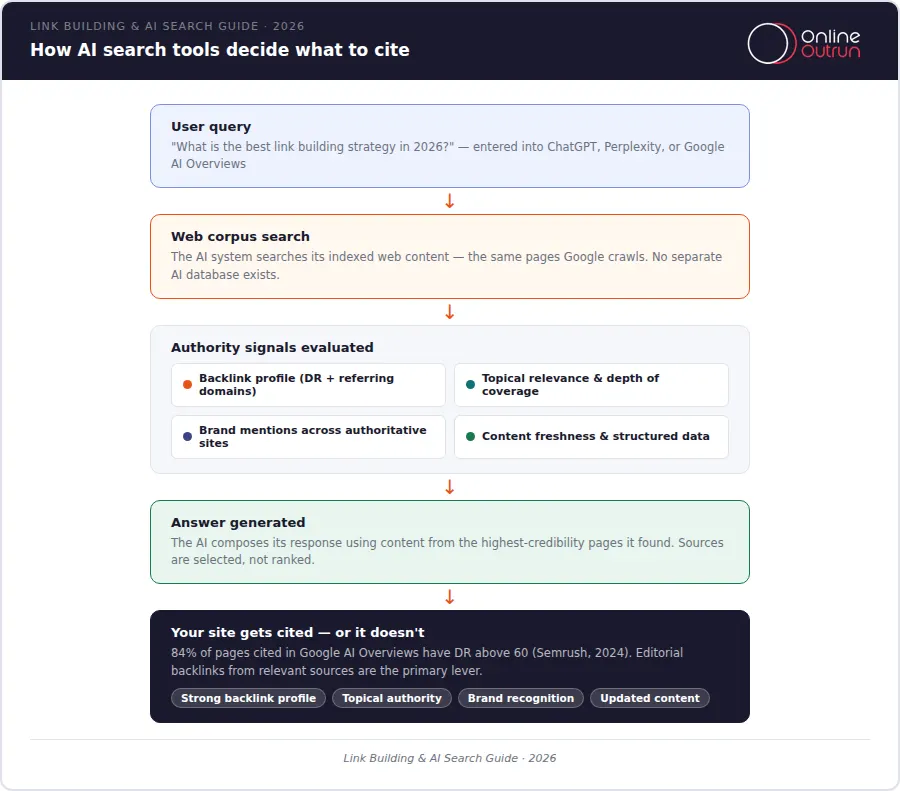
Claude, ChatGPT, Perplexity, and Google’s AI Overviews all pull answers from the web. They do not have a separate database. They read indexed content and decide what is credible enough to surface in a generated answer.
The credibility signals they rely on overlap heavily with traditional SEO:
- Backlink profile. Pages with more referring domains from relevant, authoritative sources are cited more often. This is the same mechanism Google uses to rank pages on AI systems built on top of Google’s index inherit those biases.
- Brand mentions. LLMs are trained on web text. Brands that appear repeatedly across credible publications get absorbed into the model’s understanding of the space. When someone asks ChatGPT to recommend a link building agency, it draws on what it has read and that includes brand mentions without hyperlinks.
- Topical depth. A site with 40 pages covering link building from every angle is more likely to be cited on a specific link building question than a site with one general SEO guide. AI tools look for authority within a topic, not just across the domain.
- Freshness. Google AI Overviews tend to pull from recently updated pages when the query has recency signals. Blog posts updated in the last six months appear more often than identical content from 2021.
A analysis by Semrush found that 84% of sources cited in Google AI Overviews had a DR above 60. That does not mean low-DR sites never get cited, but the pattern is clear enough to act on.
Why traditional link building still drives AI visibility
Some marketers treat AI search as a separate channel that needs its own strategy. That framing creates unnecessary complexity.
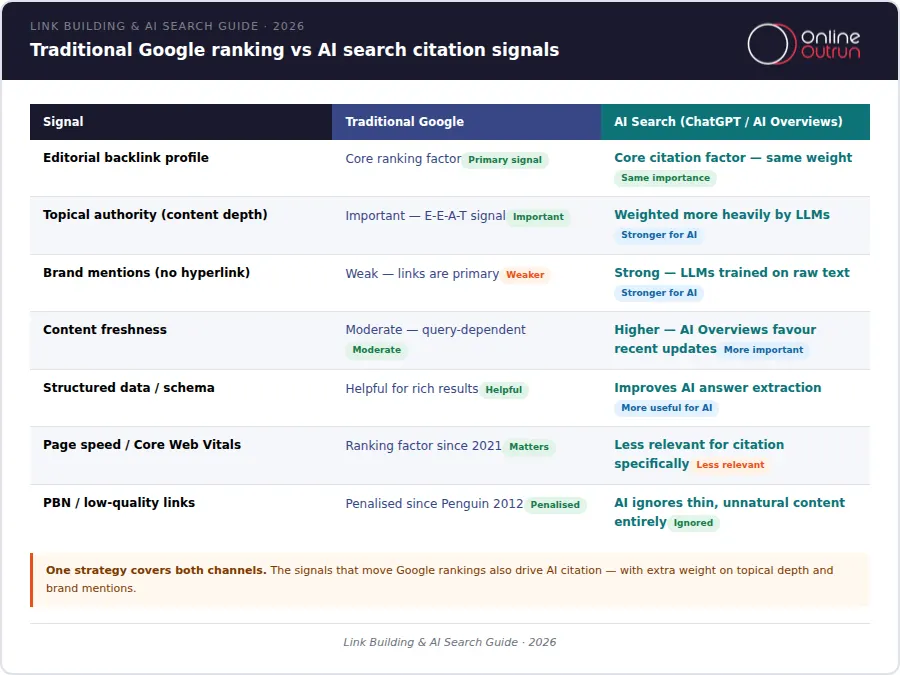
The signals AI tools use to identify credible sources are built on the same infrastructure as search rankings. A page with strong editorial backlinks, cited by relevant industry sites, with thorough topical coverage ranks well on Google and gets pulled into AI answers. These are not two separate outcomes from two separate strategies.
| Traditional Google ranking | AI search citation signal |
| Strong backlink profile | Same (high correlation with AI citation) |
| Topical authority across content | Same (LLMs weight depth of coverage) |
| Brand mentions across the web | Stronger for AI(mentions without links also count) |
| Freshness of content | More important for AI Overviews |
| Structured data / schema | Helpful for AI answer extraction |
| Page speed / Core Web Vitals | Less relevant for AI citation specifically |
The one area where AI search diverges from traditional SEO is brand mentions without links. Google’s algorithm gives most weight to actual hyperlinks. LLMs, because they are trained on raw web text, absorb unlinked mentions as trust signals too.
That means digital PR is getting your brand mentioned in major publications even without a backlink that contributes to AI visibility in a way that pure link-count metrics miss. But the most efficient path still runs through building editorial backlinks, because every editorial placement also generates a brand mention.
What link building looks like when you are optimising for AI search
Build topical authority, not just domain authority
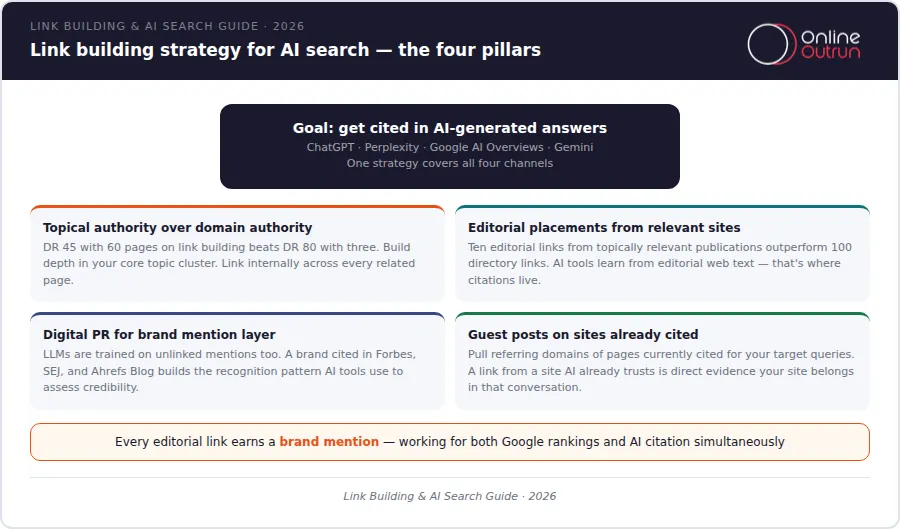
Domain authority is a useful proxy metric, but AI tools care more about whether your site is a recognised authority on a specific topic. A site with DR 45 and 60 pages covering link building in depth is more likely to get cited in a link building query than a DR 80 general marketing blog with three posts on the subject.
The way to build topical authority that LLMs trust is to publish comprehensive, well-sourced content on your core topics and earn links from sites that cover the same territory. Internal linking across your topic cluster signals to both Google and AI tools that your site understands the subject at depth.
Prioritise editorial placements over directory links
A mention in an industry publication carries far more weight in AI training data than a directory listing. AI models are trained on text that looks like editorial writing. A journalist citing your data in a Forbes article contributes to your AI visibility. A listing on a business directory does not.
This is the core argument for earning editorial backlinks from authoritative sources rather than pursuing volume-based link building. Ten editorial links from relevant industry publications do more for your AI citation rate than 100 links from low-quality directories.
Digital PR drives the brand mention layer
For AI search specifically, getting your brand mentioned in authoritative publications matters even when there is no hyperlink. Research published by Wil Reynolds in 2026 found that brands mentioned frequently across high-authority web content appeared in AI-generated answers at significantly higher rates than equally-authoritative brands with fewer mentions.
Digital PR campaigns includes original research, data studies, expert commentary placed in industry media to generate both the backlink and the brand mention. They also tend to earn secondary citations as other publications pick up the story.
Guest posts on topically relevant sites
Guest posting still works for both Google and AI search, but the placement requirements have tightened. A guest post on a general content mill contributes little to either traditional rankings or AI visibility. A guest post on a respected industry publication, where the author is identified by name and the content is genuinely useful, contributes to both.
For AI citation specifically, the relevance of the host publication matters more than its domain authority. A link from a mid-DR blog that covers SEO exclusively is more valuable for link building AI search visibility than a high-DR general marketing site that publishes on everything.
Structured citations and schema markup
Google AI Overviews pull structured data when it is available. Adding FAQ schema, HowTo schema, and Article schema to your content makes it easier for AI systems to extract specific answers and attribute them to your site. This is not a replacement for links, but it improves the probability that a page with strong links gets cited rather than skipped over.
| Want links that drive both Google rankings and AI visibility? Online Outrun builds editorial backlinks from topically relevant, high-authority sources. Every placement is manual outreach no PBNs, no directories, no shortcuts. Get a free consultation |
The practical steps to rank in ChatGPT and Google AI Overviews
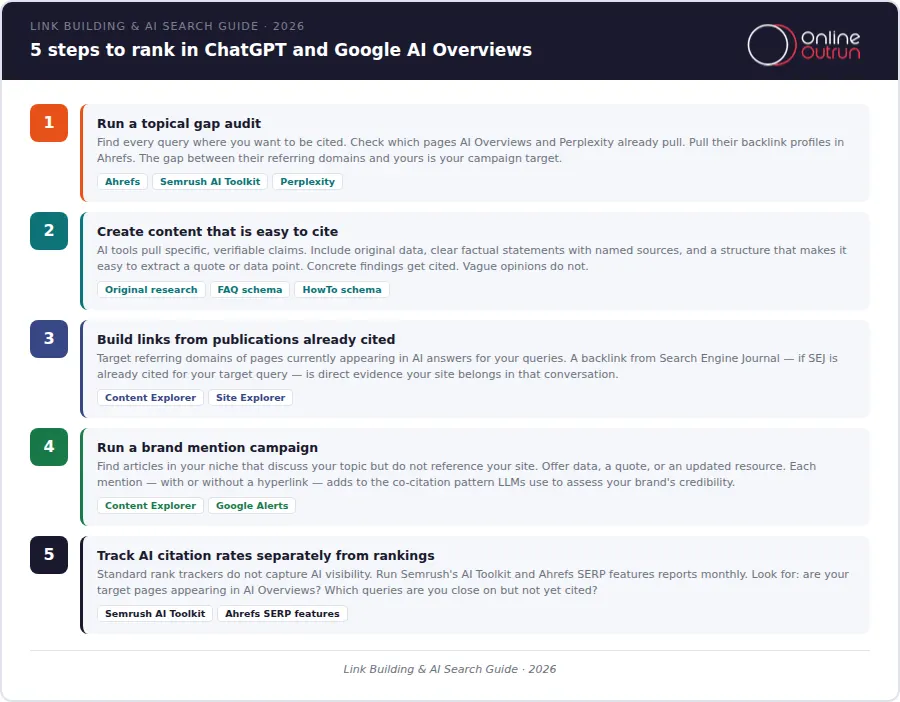
Step 1: Run a topical gap audit
Pull a list of every query in your niche where you want to be cited. Check what sources Google AI Overviews and Perplexity are already pulling for those queries. Use Ahrefs to check the backlink profiles of the cited pages.
The gap between your site’s referring domains and the cited sites is your starting point. You need enough editorial backlinks from relevant sources to be competitive and you need content that covers the topic as thoroughly as the pages currently being cited.
Step 2: Create content that is easy to cite
AI tools pull specific, verifiable claims. Pages that get cited tend to have: clear factual statements, original data or research, expert attribution, and a structure that makes it easy to extract a quote or data point.
Walls of generic commentary do not get cited. Concrete findings do. If you publish a study showing that sites with 20 or more referring domains in a niche rank in AI Overviews 3x more often than sites with fewer than five, that claim is citable. It gives AI a reason to pull your page.
Step 3: Build links from publications that are already cited
Pull the referring domains of the pages currently cited for your target queries. These are your highest-priority outreach targets. If Search Engine Journal is cited for a query you want to own, a backlink from Search Engine Journal is direct evidence to Google’s AI systems that your site belongs in that conversation.
This is the most targeted form of link building for AI search visibility. You are not just building domain authority, you are getting vouched for by the exact sources AI tools already trust.
Step 4: Run a brand mention campaign
Map where your brand is not mentioned but should be. Use Ahrefs Content Explorer or Google Alerts to find articles in your niche that discuss your topic but do not reference your site. Reach out and offer to contribute data, a quote, or a more up-to-date resource.
Each mention you earn with or without a hyperlink adds to the pattern of co-citation that LLMs use to assess your brand’s credibility in the space.
Step 5: Track AI citation rates separately from rankings
AI visibility is not fully captured by position tracking tools. Semrush launched an AI visibility toolkit that tracks citation rates across Google AI Overviews. Ahrefs added similar tracking in their SERP features section. Run these reports monthly alongside your standard rank tracker.
You are looking for: are your target pages appearing in AI Overviews for their primary keywords? Is the trend moving in the right direction as you build more topically relevant links? Which queries are you close on but not yet being cited?
What does not work for AI search visibility
The tactics that Google has devalued over the last few years are even less effective for AI citation:
- PBN links. AI training data comes from editorial web content. Private blog networks have thin, unnatural content that LLMs have essentially learned to ignore.
- Irrelevant high-DR links. A backlink from a DR 80 casino site pointing at your SEO blog does not contribute to topical authority. AI tools assess relevance at the page and domain level, not just DR.
- Mass guest posting on generic sites. Guest posts on sites that publish everything from recipes to legal advice carry no topical signal. The host site has no concentrated authority in your niche.
- Anchor text manipulation. LLMs are not reading anchor text as a ranking signal. Over-optimised anchor text that looks manipulative to Google also produces link profiles that credible publishers will not replicate, which limits your reach into authoritative citation networks.
| What this means in practiceThe shift to AI search raises the bar for link quality, but it does not change the direction of the strategy. You still want links from credible, relevant sources. The difference is that the consequences of getting this wrong have increased, low-quality link building is now a drag on two channels simultaneously. |
Conclusion
AI search is not a separate channel that needs a separate strategy. The signals that determine whether your brand appears in ChatGPT answers, Perplexity citations, and Google AI Overviews are built on the same foundation as traditional search rankings: editorial backlinks from relevant sources, comprehensive topical coverage, and brand recognition across authoritative web content.
The companies appearing in AI-generated answers right now are not running AI-specific campaigns. They built strong, relevant backlink profiles over time, published content that is genuinely citable, and earned brand mentions in publications their audience trusts.
That is the strategy. The timeline is the same as traditional link building three to six months for measurable impact, six to twelve for compounding results. Starting now puts you ahead of competitors who are still waiting to see how AI search settles.
FAQs – Link Building & AI Search
Does link building help you rank in Google AI Overviews?
Yes, directly. Semrush’s AI Visibility Report found that 84% of pages cited in Google AI Overviews had a DR above 60, and pages with more unique referring domains appeared at significantly higher rates. Link building is the primary mechanism for building the domain and page authority that AI Overviews use to select sources.
How do you get cited in ChatGPT?
ChatGPT with search enabled indexes web content through Bing. Pages with strong backlink profiles, original content, and brand mentions across authoritative publications are more likely to appear in ChatGPT answers. The strategy is the same as for traditional SEO, with additional emphasis on brand mentions and topical depth.
How long does it take for link building to affect AI search visibility?
Similar timelines to traditional SEO. Links need to be crawled and indexed, and AI Overviews update as Google recrawls content. Most campaigns start showing measurable improvement in AI citation rates within three to six months of consistent link acquisition from relevant sources.
Do brand mentions without links help AI search visibility?
Yes, particularly for LLMs like Claude, ChatGPT and Perplexity that are trained on raw web text. Brands mentioned frequently in high-authority editorial contexts appear in AI-generated recommendations at higher rates than brands with identical link profiles but fewer mentions. Editorial link building generates both the backlink and the brand mention, so the two are not mutually exclusive.
What is the best type of link building for AI search?
Editorial placements from topically relevant publications. Digital PR that generates coverage in recognised industry media. Guest posts on sites that are themselves cited in AI answers for your target queries. These are the placements that feed both traditional rankings and AI citation simultaneously.
Should I outsource link building for AI search?
If you do not have an in-house outreach team and an established publisher network in your niche, yes. The type of link building that drives AI visibility are editorial placements, digital PR, topically relevant guest posts. This requires consistent manual outreach and relationships that take time to build. Outsourcing link building for AI search to a specialist agency accelerates that process significantly.